Thirst

I’ve said it before and it will probably always be true: if it weren’t for my husband, my houseplants would be dead. I love plants, or at least I say I do, but I forget to water them. It builds endurance, right? I don’t think they appreciate it. I’m sure you’ve had a plant or flower that was a little neglected and became wilted and drooping over, but once you gave it some water, before long it straightened up and filled out – happy and thriving instead of barely hanging on to its little plant life.

I was listening to a message by Tim Keller yesterday about Psalm 1: the first of many wonderful rich poems, desperate laments, mountain-top celebrations and heartfelt prayers to God and about God. Here it is:

1 Oh, the joys of those who do not
follow the advice of the wicked,
or stand around with sinners,
or join in with mockers.

2 But they delight in the law of the Lord,
meditating on it day and night.

3 They are like trees planted along the riverbank,
bearing fruit each season.
Their leaves never wither,
and they prosper in all they do.

4 But not the wicked!
They are like worthless chaff,
scattered by the wind.

5 They will be condemned at the time of judgment.
Sinners will have no place among the godly.

6 For the Lord watches over the path of the godly,
but the path of the wicked leads to destruction.

Tim’s message focused on the necessity of meditating on God’s Word so we can thrive, but I also gained some new perspective on a few other things.

Jesus had a conversation with a Samaritan woman once and told her if she only knew the gift God had for her she would ask for Living Water. “Anyone who drinks this water will soon become thirsty again. But those who drink the water I give will never be thirsty again. It becomes a fresh, bubbling spring within them, giving them eternal life,” (John 4:13-14). That thirst is the inner thirst we all have, the sometimes seemingly unquenchable yearning in our hearts for what we lack. We look to and “drink in” all sorts of things and people to try and satisfy the thirst, but none of it lasts or truly satisfies. Some can even be toxic. We are barely surviving spiritually (which affects our entire life, physically and otherwise).

Among many other things, God once told Jeremiah, the prophet, to warn His people about this:

They [my people] have abandoned me—the fountain of living water.
And they have dug for themselves cracked cisterns that can hold no water at all! Jeremiah 2:13

In our self-sufficiency we think we’re doing fine when all the while our roots are shriveling and starving, a malnourished tree trying to grow in dry, cracked dirt.

For a short time, could it be that Jesus even knew this feeling? We read these words in Psalm 22, a specific and accurate prophecy about Jesus’ crucifixion:

14 My life is poured out like water,
and all my bones are out of joint.
My heart is like wax, melting within me.

15 My strength has dried up like sunbaked clay.
My tongue sticks to the roof of my mouth.
You have laid me in the dust and left me for dead.

Near the end of his death on the cross, Jesus said “I thirst.” No doubt physically he was dehydrated and truly thirsty. But Tim Keller proposed it could have also been because at that moment he was taking on our sin, essentially becoming sin, becoming the wicked who are cut off from God, detached from the source of Living Water. His life was utterly being poured out, draining out like water. He was becoming dusty, lifeless chaff to be scattered in the wind. (Psalm 1:4) That is the opposite of what He wants for us.

If you’ve ever flown in a plane, when you look down across squares of farmers’ fields, forests, neighborhoods and more, you see so many trees growing along rivers and around lakes, where they have a steady supply of water. Psalm 1 paints a beautiful picture of healthy, lush trees growing along a flowing river, always green, always fruitful when the season for that comes, fully alive and strong.

Contrary to actual trees, in a way we actually choose where we want to be planted, settle and grow. In Ephesians 4 the Apostle Paul mentions that in a most loving prayer for the people following Jesus:

16 I pray that from his [God’s] glorious, unlimited resources he will empower you with inner strength through his Spirit. 17 Then Christ will make his home in your hearts as you trust in him. Your roots will grow down into God’s love and keep you strong. 

And Jesus said He’s the Vine and we’re his branches. (John 15:5) He said without Him we can do nothing. But as long as we abide in Him, stay attached to Him, we’ll bear fruit – we’ll have all we need. We’ll have Him.

Unlike my poor houseplants, we have a Father who is not only attentive and caring, but always with us. He is the Living Water, the ever bubbling, even gushing, pure source of life and everything good. He provides more than we need and is the same yesterday, today and forever. Why would we want to plant ourselves anywhere else?

Scriptures used are in the New Living Translation
Tim Keller’s podcast and messages: https://open.spotify.com/show/5hYDVSeY9KWSpkI4YlSzKF?si=W0uS2LlhSJ-Lggv7WzPkYA

I’m so glad I have problems

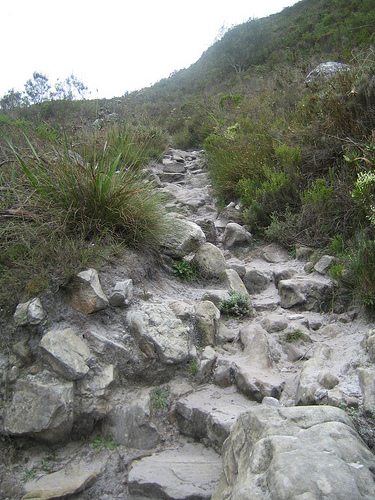
rocky pathThe path we walk when we follow Jesus has potholes. This isn’t a complaint, it’s just the truth. The path is not a wide, paved, beautifully landscaped street but more like a rocky, narrow, twisting, sometimes harrowing trail that is downright difficult to walk at times. It will push us to our limits and beyond, test our resolve, even bring us pain. There are times we might even question, “why did I agree to come this way?”

Jesus never said it would be a stroll in the park, but He did say not to lose heart when we we’re having trouble because He’s overcome the world. (John 16:33) Following someone who’s overcome the world – pretty good credentials, don’t you think?

I’ve lived long enough to be able to look back and see that the path we’ve covered so far has made my faith stronger, though sometimes it takes me a minute (or more) to remember that when I’m in the middle of tough terrain.

James said we should actually be glad in our troubles, because of what they do for us. “When troubles of any kind come your way, consider it an opportunity for great joy. For you know that when your faith is tested, your endurance has a chance to grow. So let it grow, for when your endurance is fully developed, you will be perfect and complete, needing nothing.” (James 1:2-4 NLT)

It’s one thing to persevere through hard times, it’s another to actually be glad about them. If I say to someone, “I’m so glad I’m dealing with this difficult person and that they’re hurting me,” they’d probably look at me like I had two heads. But God’s thoughts are not our thoughts, His ways are not our ways. There’s no doubt about that. He doesn’t allow us to have difficulties just so He can show He’s bigger than we are, or just to have us grovel at His feet needing help. Each problem has a purpose: to make us more like Jesus and to witness to God’s goodness and glory.

Before a potter shapes clay or even puts it on the pottery wheel, he pounds it and throws it down numerous times on the table to work out any air bubbles that might be inside and would later be a problem. Before precious metals are formed into valuable objects of beauty, the refiner heats the silver or gold to melting (over 1800 degrees fahrenheit!) and then skims off the impurities as they rise to the surface.

In both cases, the creator is present and personally involved through the whole process.

Feeling like you’re taking a pounding? Or being melted down in a crucible, completely helpless? Sometimes our faith feels like a rubber band that is stretched so tightly it might break. The thought of trusting God one more day is exhausting, and then He asks us to trust another day after that.

Can we praise Him anyway? Can we trust Him? Can we remind ourselves of all He’s done for us in the past? Does knowing He promised He will bring good out of everything for those who love him help us surrender? Some days I enthusiastically answer “Yes!” Some days I have to confess to Jesus that I don’t have the strength on my own, I need Him to help me to believe. Praising Him raises our gaze to Him again and helps. It truly helps. We can have peace that steadies our weak legs and can make it through.

I tried to express this to a friend who was losing someone she loved. It felt almost insensitive to encourage someone to thank God in everything when their troubles are so personal, so deeply painful. How do you tell someone to be glad that they’re having to deal with that? The act of giving thanks in difficulty is part of the refining process. That decision alone can be excruciating.

All I know is that God proves Himself loving and good when we give in and praise Him even in that kind of loss. He shows understanding and compassion. He knows the deepest places of our hearts. It was too hard for my friend, but I still pray God will show her how much He loves her and that she can trust Him.

The end result of trusting God and even thanking Him through troubles is worth the pain. I don’t want to stay the same, do you? I don’t want to walk an easy path if it’s without Jesus. If problems help refine me, then I’m glad I have them. I will try to remember to thank God when they come. I want to grow and reach my goal: to be with God forever and ever, without blemish or fault, without any more struggle with this world or myself…free and home.

So be truly glad. There is wonderful joy ahead, even though you must endure many trials for a little while. These trials will show that your faith is genuine. It is being tested as fire tests and purifies gold—though your faith is far more precious than mere gold. (I Peter 1:6-7 NLT)

Standing by while you hurt

Someday you’ll understand how much I mean it when I say that when you’re happy, I’m really happy and when you hurt, I hurt.  It’s because I love you so much, more than I could ever make you understand.  But someday when you’re a mom and you have to stand by and watch your child learn through hurt, you’ll know what I mean.

I think of the time your daddy had to stand by and watch you get stitches in your lip.  You didn’t cry much but it wasn’t easy for him to do.  He knew it was for your good so he stood by.  He didn’t get in the way of the doctor or try to prevent it from happening.

I remember the heartbreaking time I had to hold you with both arms on my lap while you squirmed and screamed, as a nurse drew your blood for an important test.  Of course you didn’t understand since you were so young, but I had to because it was going to help you.

You know how it was when we used to plant flowers in front of the house and then water them really well.  Sometimes they were so small and fragile that the water pouring down seemed to flatten them.  However, the next day, Continue reading

On being dirty and knowing it

As part of my morning routine, I’m reading a devotional book in which there is an excerpt from one of C.S. Lewis’ books for each day.  They’re short and they’re all from books he wrote about faith…very interesting.  Sometimes they’re pretty deep for 6 in the morning, but most of the time they open my eyes to new ways of understanding this Christian journey I’m on.

Today’s was about how we view ourselves as good, bad or otherwise.  A person who has begun to be cleansed/changed by God begins to see more and more how bad they really are/were.  But a person who hasn’t begun that process has no frame of reference for good or bad and thinks they’re pretty good.  It’s a little confusing but I thought of this illustration:  there have been times when I’ve cleaned a spot on the carpet where someone spilled something or one of the animals didn’t quite make it outside and afterward the spot I cleaned is noticeably brighter and cleaner than the rest of the surrounding carpet.  It’s only then that I realize how dirty the whole carpet must be!  Yikes.

spotlightOr think of yourself wearing black clothes in a moderately dark room.  You could be covered in lint and “fuzzies” but none really show because of your dim surroundings.  Walk into a bright spotlight, like the ones they use in a play, and suddenly every little speck, hair or particle is visible to everyone.  Flaws and smudges you didn’t even realize were there are suddenly glaringly obvious.

As we grow closer to and more like Jesus, allowing God to prune away more and more of our old sinful selves, we realize what sad shape we were in and would still be in if it weren’t for his love and grace!   The more he washes us the more we realize we need to be washed.  Does that make sense? Continue reading